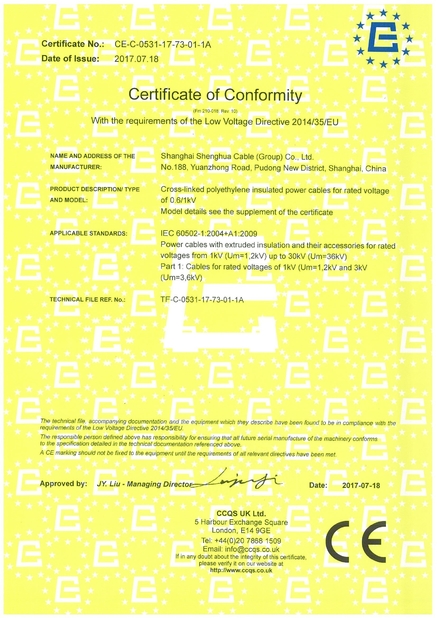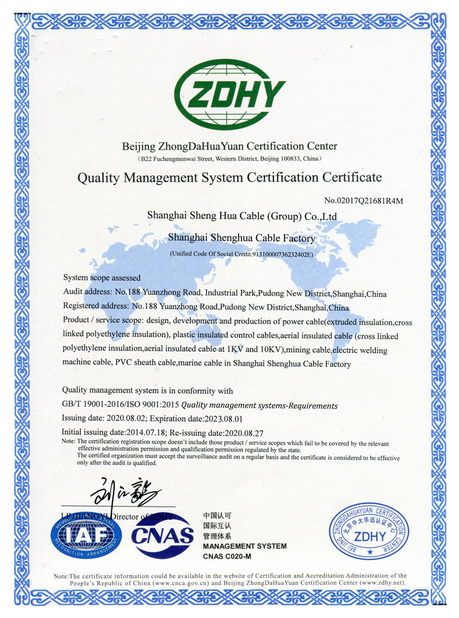
شانغهاي Shenghua كبل (مجموعة) المحدودة
Cable working temperature is the single number that decides how much current a cable can carry and how long it will last, yet it is frequently missing from purchase enquiries. A cable rated 70 degrees Celsius and one rated 90 degrees Celsius can have identical copper and identical dimensions, but the second carries roughly 15 to 20 percent more current and ages far more slowly in a hot plant room. This guide explains what the temperature rating actually refers to, how PVC, XLPE, XLPO and silicone compare, why every 8 to 10 degrees of sustained over-temperature halves insulation life, and how to apply ambient and grouping derating factors correctly. It closes with six answers on short circuit ratings, high temperature locations and the practical limits of each insulation type.

A cable temperature rating is the maximum continuous conductor temperature at which the insulation is expected to give its design life, normally 20 to 30 years. It is not the ambient air temperature and it is not the sheath surface temperature. The conductor runs hotter than the sheath, and the sheath runs hotter than the air, so a cable in a 40 degrees Celsius plant room with a 90 degrees Celsius rating has a thermal reserve of about 50 degrees for the current it carries.
Each insulation family has its own limit, defined by the point at which the polymer begins to soften, oxidise or release volatiles:
| Insulation | Continuous conductor temp | Short circuit allowance | Relative current capacity |
|---|---|---|---|
| PVC | 70 C | 160 C | Baseline |
| XLPE | 90 C | 250 C | About 15-20 percent higher |
| XLPO / EPR | 90-120 C | 250 C | Similar to XLPE |
| Silicone | 180-200 C | 350 C | Lower per mm2, used for heat |
The rating applies to the conductor, and it assumes a defined set of installation conditions: a reference ambient of 30 degrees Celsius in air, a defined grouping, and a defined method of installation. Change any of those and the permissible current changes, which is why a current rating taken from a catalogue without correction is not a design.
Insulation ageing is a chemical reaction, and like most chemical reactions its rate rises exponentially with temperature. In practice, a sustained over-temperature of 8 to 10 degrees Celsius reduces the service life of PVC or XLPE insulation by roughly half. That relationship explains why thermal design deserves more attention than it usually receives.
1. Current capacity and cable size. Because XLPE allows a 90 degrees conductor, a 4x35 mm2 XLPE cable carries noticeably more current than a 4x35 mm2 PVC cable under the same conditions. For a given load, the XLPE option may allow a smaller cross section, which saves copper, weight and tray space. In many projects the XLPE cable is cheaper in total even when its price per metre is higher.
2. Life at elevated ambient. A cable installed in a boiler room, a roof void, a steel mill or a solar inverter enclosure operates above the reference ambient every day. If the current is not derated, the conductor runs beyond its rating and the insulation ages at double or triple speed. The result is a cable that passes commissioning and fails at year seven.
3. Termination behaviour. High conductor temperature accelerates oxidation at the terminal interface. A joint or lug that is correctly torqued at installation can loosen after years of thermal cycling, and a loose joint at 90 degrees Celsius deteriorates much faster than at 70. This is why high temperature circuits require Terminations rated for the same class as the cable and periodic thermographic inspection.
4. Short circuit withstand. The short circuit allowance is not a continuous rating, but it sets the minimum cross section for a given fault level and protection time. A PVC insulated cable at 160 degrees Celsius has less margin than an XLPE cable at 250, so a smaller XLPE cable can sometimes satisfy the fault withstand where PVC would need a larger size.
5. Regulatory and insurance compliance. Many installation codes require the cable rating to be not less than the operating temperature of the equipment it serves. A PVC cable connected to equipment with 85 degrees Celsius terminals is non-compliant regardless of current, and an insurer or inspector may reject the installation even if it works.
Start with the real ambient. Measure or obtain the design air temperature at the cable route, not the average for the building. Roof voids, ceiling plenums, boiler rooms, plant rooms and enclosures can be 15 to 25 degrees above the general ambient. Add the solar gain if any part of the route is exposed, and add the effect of adjacent heat sources such as steam lines or furnaces.
Then apply the correction factors in the right order: ambient temperature factor, grouping factor for cables in a bunch, and installation method factor. For example, a 4x25 mm2 copper XLPE cable rated 110 A in free air at 30 degrees Celsius might fall to about 95 A at 45 degrees ambient, and to about 80 A if it is grouped with three other loaded cables in a tray. Sizing on the catalogue figure of 110 A would overload the cable by nearly 40 percent. Rating software automates the arithmetic, but the input data still has to be right, and the most common mistake is to use the ambient of the switch room for a cable that runs through an unventilated riser.
Check the equipment interface. A cable must not be connected to equipment whose terminal rating is higher than the cable rating. If a motor terminal block is rated 90 degrees, a PVC cable rated 70 is not suitable, regardless of current, and the correct answer is XLPE or a heat resistant connection. Similarly, where a cable passes through a high temperature zone, consider a silicone or glass braided section rather than a single high temperature cable for the whole route.
Verify the short circuit duty. Calculate the fault current and the protection clearing time, then check the permitted short circuit temperature for the insulation and the minimum cross section from the adiabatic equation. This check often governs the earth conductor size, which is where many designs are quietly non-compliant.
Finally, design for inspection. Thermographic surveys of terminations and joints at commissioning and annually thereafter will find loose connections before they fail. Record the conductor temperature under normal load; a cable running 20 degrees above the design value is telling you that the derating was wrong, and the cheapest time to correct it is before the insulation has aged.
| Location | Typical ambient | Recommended insulation |
|---|---|---|
| Air conditioned plant room | 25-30 C | PVC or XLPE |
| General industrial hall | 35-45 C | XLPE preferred |
| Roof void or plenum | 45-55 C | XLPE, derated |
| Boiler or furnace area | 60-90 C | Silicone or special cable |
| Solar inverter enclosure | 50-60 C | XLPE or XLPO, DC rated |
| Buried duct | 20-25 C soil | XLPE or PVC with soil factor |
Representative constructions include the CU/XLPE/PVC 0.6/1 kV 3x120 plus 2x70mm2 cable for general distribution, the 19/33 kV three core screened XLPE cable 3x300 mm2 for high voltage feeders, and the PVC sheathed 3Cx300 XLPE cable for heavy distribution. Standard 90 degrees Celsius XLPE multi-core cable with a PVC jacket is covered by the 90 degrees 2-5 core XLPE cable, while installations requiring a defined length and UL reference can use the UL standard 500 metre PVC insulated multi-core cable. Where mechanical protection is needed underground, the steel wire armoured multi-core PVC cable is a common choice, and double jacket constructions such as the double PVC jacket 7x26 600 V cable add mechanical and moisture protection.
Two tests matter when a buyer wants evidence rather than a data sheet. The first is the type test for current rating, in which a sample of the finished cable is loaded at the rated current under defined conditions and the conductor temperature rise is measured until it stabilises; the resulting temperature must not exceed the insulation limit at the reference ambient. The second is the long term ageing test, in which insulation samples are held at an elevated temperature for a defined period and the retained tensile strength and elongation are measured. Both are type tests rather than routine tests, so they should be available as reports for the product family rather than for each drum. A supplier who cannot produce a current rating type test for a claimed 90 degrees Celsius construction is asking the buyer to accept an assumption.
Solar inverters are often mounted in a metal enclosure that reaches 55 to 60 degrees Celsius in summer, and the DC and AC cables enter through the bottom of that enclosure. A PVC insulated AC cable rated 70 degrees Celsius would have almost no thermal margin at the terminals, and a design that assumed a 30 degree ambient would overload it by a third. The correct approach is XLPE or XLPO insulation rated 90 degrees or higher, a current rating corrected for the enclosure ambient, and terminations rated for the same class. Where the inverter manufacturer specifies a 75 degrees Celsius terminal rating, the cable must match or exceed it. The same logic applies inside battery storage containers, where the ambient is controlled but the cable trays pass close to hot equipment, and to rooftop combiner boxes where the enclosure is in direct sun.
No. The rating is the maximum conductor temperature. The permitted ambient depends on the current, the installation method and the derating factors applied to that rating.
Only within the short circuit allowance of about 160 degrees Celsius for a few seconds, and only during a fault. Continuous operation above 70 degrees Celsius ages PVC rapidly.
Because XLPE permits a 90 degrees Celsius conductor instead of 70, the temperature rise available for the same ambient is larger, so the permissible current is roughly 15-20 percent higher.
The insulation oxidises and embrittles, plasticiser migrates in PVC, and mechanical and dielectric properties fall. As a rule, every 8-10 degrees of sustained over-temperature halves the service life.
Yes, usually XLPE with derating for the higher ambient, and in many codes a fire performance requirement applies as well. PVC in a hot plenum is a common design error.
The short circuit allowance is a brief excursion, for example 250 degrees Celsius for up to five seconds for XLPE, used to size the conductor for fault withstand, not for continuous loading.
Temperature is not a footnote in cable selection; it is the parameter that sets current capacity, insulation life and often the cable size itself. Establish the real ambient along the route, apply ambient, grouping and installation factors in the correct order, check the equipment terminal rating, and verify the short circuit withstand. Then confirm the installation with a thermographic survey under load, because the first survey is worth more than any calculation. Shanghai Shenghua Cable Group manufactures PVC, XLPE, XLPO and high temperature cable from 0.6/1 kV distribution to 33 kV screened designs, with current rating tables and derating data supplied on request. Send your route conditions, load profile and ambient data through our contact page and our engineers will return a sized cable schedule with the derating calculation attached.