شانغهاي Shenghua كبل (مجموعة) المحدودة
A cable test certificate is only useful if the buyer can tell which of the three test categories it reports, because routine, sample and type tests prove very different things. A routine test certificate confirms that a particular drum passed a voltage and resistance check; it says nothing about flame performance, sheath thickness compliance or compound quality. This guide explains the three levels defined in IEC 60502-1 practice, what each certificate should contain for PVC insulated cable, how to compare measured values against the standard limits, and what to request for a project of each size. It ends with six answers on batch traceability, third party certification and the warning signs of a certificate that was not produced by a laboratory.

Cable standards divide testing into three levels, and confusing them is the single most common error in procurement review.
| Category | Frequency | Typical content | What it proves |
|---|---|---|---|
| Routine | Every length | Conductor resistance, voltage test | This drum is electrically sound |
| Sample | Per batch or period | Dimensions, mechanical properties | Production is within dimensional limits |
| Type | Once per design | Flame, impact, ageing, shrinkage | The design meets the standard |
| Third party | On request | Witnessed or independent testing | The claim has external verification |
A buyer who receives a routine test certificate and assumes it covers flame performance has misunderstood the document. Conversely, a buyer who demands type test reports for every drum is asking for something that does not exist by definition, and the resulting delay is usually resolved by accepting a document that proves less than intended.
Certificate review is not paperwork for its own sake. Three specific failure modes are detected by reading the document properly, and all three are expensive when missed.
1. Conductor cross section shortfall. A cable described as 25 mm2 that is actually built with 24 mm2 of copper will pass a voltage test and look correct. It shows up in the measured conductor resistance, which is recorded on the routine certificate and can be compared with the standard maximum for that class and size. Buyers who read that one number have an effective defence against one of the oldest tricks in the trade.
2. Insulation and sheath thickness. Sample test results record the measured minimum thickness at the thinnest point, not the average. A cable with an average thickness within tolerance but a minimum below the standard limit has a weak point along its length, and that weak point is where a fault will eventually start.
3. Compound substitution. A certificate that reports flame performance for a type test on a different construction, or that omits the compound designation entirely, is a warning sign. So is a certificate with no batch number, no manufacturing date and no reference to the standard clause being satisfied. Those omissions usually mean the document was assembled from templates rather than generated from production data.
4. Traceability failure. If the drum label carries batch A and the certificate covers batch B, nothing in the document proves anything about the delivered material. Traceability is the first thing an auditor checks and the first thing a claimant needs.
5. Tender and insurance requirements. Public projects frequently require type test reports from an accredited laboratory, and insurers may ask for evidence of flame performance in occupied buildings. A supplier who can produce them at bid stage is a lower risk than one who promises to obtain them after the order.
Begin with the standard reference. The certificate should name the product standard, the construction, the voltage class and the conductor class, and it should identify the specific clauses that were tested. A document that only says the cable meets the standard without listing the tests is a declaration, not a certificate.
Then compare values, not pass marks. Read the measured conductor resistance against the maximum permitted for the size and class, the measured insulation thickness against the minimum, and the voltage test level and duration against the standard value. For a 0.6/1 kV PVC cable, the routine voltage test is typically applied at a defined multiple of the rated voltage for a defined time; a certificate that reports a much lower test voltage is not equivalent, whatever the pass stamp says.
Match for the scale of the project. For a single drum purchase, a routine certificate plus dimensional data is usually sufficient. For a project with multiple deliveries, require sample test results per batch and a type test report for each construction family. For infrastructure, public buildings and export contracts, require type test reports from an accredited third party laboratory, and check that the laboratory's scope covers the test performed.
Consider independent verification for high value orders. A retained sample of two to three metres per batch, sealed and stored, allows later laboratory comparison of dimensions, compound and mechanical properties. The cost is trivial compared with the value of the cable, and it converts a dispute from an argument into a measurement.
Finally, keep the documents with the delivery record. A certificate that cannot be matched to a drum and a project location is of little use two years later when a question arises, and the filing is the cheapest part of the whole process.
| Document | What to check | Warning sign |
|---|---|---|
| Routine certificate | Conductor resistance against standard maximum | No measured values, only pass stamps |
| Sample test report | Minimum insulation and sheath thickness | Average values only |
| Type test report | Construction matches the ordered product | Report for a different size or compound |
| Certificate of conformity | Batch and date match the drum label | No batch or date reference |
| Third party report | Accredited laboratory and scope | Laboratory not accredited for the test |
Products where these documents are routinely supplied include the NYY 4x25mm2 oxygen free copper PVC cable, the N2XRY 4x35mm2 wire armoured cable, and the unarmoured PVC control cable for indoor trenches. Flame performance is verified for products such as the YJV22 steel tape armoured cable and the NYY and NYCY fire resistant building cable, and low smoke behaviour by the customised colour LSZH cable. Export projects with third party requirements typically specify products such as the flexible control wire with CE and KEMA certification or the BVR 1x4mm2 building wire with a declared conformity route.
A well produced certificate is easy to recognise. It carries the manufacturer's name and address, the product description with the full designation, the standard and clause references, the batch number and manufacturing date, the drum or length identification, the test date, the measured values with the applicable limits printed alongside, and the signature of the responsible person with a test stamp. Nothing on that list is decorative: each item answers a question that arises if the cable is questioned later.
Two details are worth insisting on. The limits should be printed next to the measured values, so that a reader does not need the standard open to judge compliance. And the certificate should state the test temperature and the conditioning used for mechanical tests, because mechanical results at a different conditioning are not comparable with the standard values. A certificate without those two details is a record of activity rather than evidence of conformity.
When a dispute arises about conductor size, sheath thickness or compound quality, the outcome depends almost entirely on what was retained. Three metres of cable per batch, sealed, labelled with the batch and date, and stored indoors, is enough for a laboratory to measure dimensions, conductor resistance, tensile strength and elongation, and to compare the compound against a reference. Without that sample, the discussion becomes a comparison of opinions between two parties who each hold a different length of cable.
The cost of retaining samples is negligible, and the practice changes supplier behaviour as well, because a supplier who knows that a sample will be retained and possibly tested tends to be more careful with the certificate in the first place. For projects with multiple deliveries over months, the retained sample set becomes a de facto quality record across the whole contract.
A certificate is one element of a quality chain that also includes factory acceptance, pre-shipment inspection and incoming goods verification. For projects of any size, three steps make the chain complete. First, agree the test plan at order stage, listing which tests will be witnessed, which will be documented and which will be verified independently. Second, inspect a drum end at pre-shipment: measure the overall diameter, check the sheath print against the specification and confirm the label batch. Third, verify on receipt that the drum label, the packing list and the certificate agree, and retain a sample.
Each step takes minutes and catches a different class of error. The test plan catches misunderstandings before production; the pre-shipment check catches a wrong product before it travels; the receipt check catches a documentation mismatch before the cable is installed in a place where it cannot easily be removed. Buyers who run all three rarely need to argue about quality at all, because problems are found while they are still cheap.
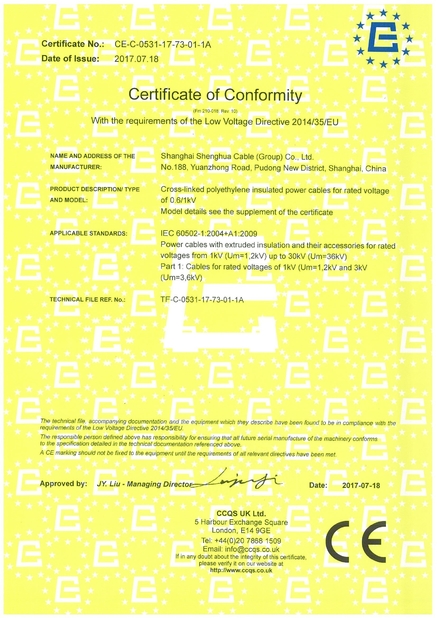
Suppliers issue several document types under similar names, and the difference matters. A certificate of conformity states that the product meets a specification, without test values. A routine test certificate reports the measured values for a specific length. A type test report describes the design verification, sometimes from an earlier year and a different size. An inspection certificate from a third party records that a representative witnessed the tests, not that the product is good in absolute terms.
None of these covers installation quality, which is where most failures actually originate: a joint made with the wrong die, a cable pulled over a sharp edge or a sheath damaged during backfill. That is why the certificate should be treated as the start of the record rather than the end, and why the commissioning test values belong in the same file as the factory documents.
A routine test is performed on every length of finished cable. A type test is performed once on a representative construction to prove the design, and is not repeated for each batch.
A routine test certificate should accompany every delivery. Sample and type test reports are provided per batch or per construction family.
The measured conductor resistance against the standard maximum for that size and class. It is the most effective single check against a shortfall in conductor material.
For infrastructure, public buildings and many export contracts, yes. For ordinary industrial purchases, a manufacturer's type test report plus batch traceability is usually sufficient.
Check that the batch number and manufacturing date on the certificate match the drum label, and that the construction, size and standard reference match the order.
A sealed sample kept per batch allows later laboratory comparison of dimensions, compound and mechanical properties if a dispute or a failure occurs.
Reading a test certificate is a five minute skill that protects a project for decades. Identify the test category, compare measured values against standard limits, match batch numbers to drums, and keep a retained sample for anything of value. Those habits make the difference between a document that proves something and one that merely exists. Shanghai Shenghua Cable Group supplies routine test certificates with every delivery, sample and type test reports per construction, and third party reports through accredited laboratories for infrastructure and export projects. Send your specification and certification requirements through our contact page and our engineers will confirm which tests apply and provide the documentation package before shipment.